
In the early years of her career, Crystal Danbury noticed a telling divide. Technicians worked in one building, leaders in another — and the two never met. Safety memos arrived through a hatch, not through a conversation. It was a perfect metaphor for a profession often isolated from business decision-making.
“We’d joke that leadership designed safety processes for a world they’d never seen. That disconnect made us feel unsafe every day.”
Today, as one of the UK’s leading voices in safety leadership, Crystal has flipped that model entirely. Her philosophy is simple but transformative: if safety leaders want real investment, they must speak the language of business.
The moral case will always matter — but it’s the commercial case that earns attention, trust, and funding.
The Gap Between ‘Should’ and ‘ROI’
Every safety professional has felt it: that uncomfortable moment in the boardroom when passion hits a wall of polite silence.
Early in her rail career, Crystal experienced it firsthand. She presented a heartfelt plea to run her company’s first live emergency drill. “We need to do this,” she told the board. “It’s the right thing to do.” The response? A pat on the back and £1 000 to “do something small.”
“They just didn’t care — or so I thought. In reality, they cared deeply about their people. I just hadn’t shown them why it mattered to the business.”
That meeting became a turning point. It revealed the gulf between moral intent and commercial understanding. Boards make investment decisions by comparing returns across competing priorities. Marketing, operations, and finance all arrive armed with ROI models. Safety, however, often arrives with emotion — and leaves empty-handed.
“We’re the only profession that walks into a room and says, you can’t put a price on safety – you just should.”
To bridge that gap, Crystal realised she needed to re-engineer not just her message, but her entire measurement system.
Reframing Safety as a Commercial Proposition
At the heart of that re-engineering sits a deceptively simple concept: the True Cost of Harm.
For years, safety metrics focused on lag indicators — counts, ratios, tick boxes. They described what happened, not what it cost. Crystal’s approach reframes incidents in terms any finance leader can grasp: lost productivity, replacement labour, legal claims, brand impact, and insurance premiums.
“The benefit of our people is the benefit of the business.”
By translating harm into business loss, safety moves from the ethics column to the P&L column.
How the model works
- Identify three meaningful categories:
- Major Recoverable Injury — traumatic but temporary.
- Life-Changing Injury — permanent physical or psychological impact.
- Lost-Time Injury — absence-related events that reduce capacity.
- Quantify the average cost of each (wages, agency cover, overtime, downtime).
- Multiply by the organisation’s margin to show how much revenue must be generated to pay for those losses.
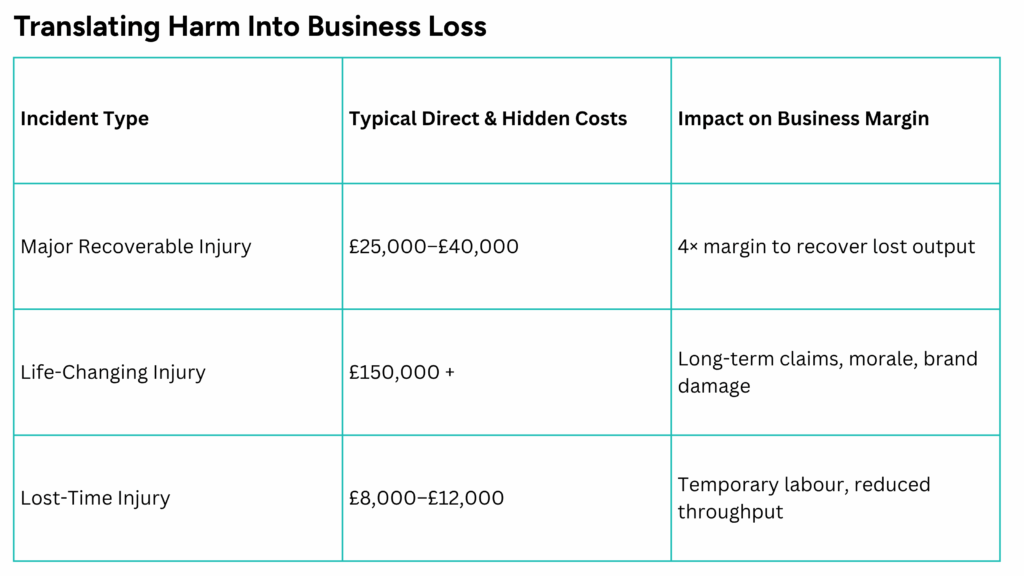
Suddenly, “we had 10 LTIs this month” becomes “we lost £100 000 of productivity and had to generate £400 000 in revenue just to stand still.” That’s the language executives understand.
Crystal encourages safety teams to go further: integrate ROI forecasts directly into investment requests. Instead of “we need telematics”, it becomes “our current RTA claims cost £X million; telematics could cut that by 30 %, generating a payback in 12 months.” It’s the same conversation marketing or sales would have — and it earns the same credibility.
From Failure to Framework: The Birth of the True Cost of Harm
The idea didn’t emerge from a workshop; it came from failure.
After that first board rejection, Crystal refused to accept defeat. She used her £1 000 “grant” to run a full-scale emergency simulation anyway. She recruited acting students from a local college, convinced the fire brigade that the police were already in, convinced the police the ambulance was in, and somehow pulled off the first live multi-agency drill in the region.
The result was electric. Regulators attended. Other rail companies turned up to learn. The board — who had expected nothing — saw tangible impact and immediately approved £10 000 for future exercises.
“They did care. I just hadn’t articulated the benefit. When they saw it, they backed it.”
That experience hardened a lesson every safety leader eventually faces: proof beats passion. The success of that exercise became the seed for the True Cost of Harm framework — a structured way to quantify both the human and commercial consequences of harm, before asking for investment.
Turning Data into Dialogue
Safety teams love data. Boards love insight. They are not the same thing.
Crystal found that traditional safety reporting often overwhelmed executives with volume: 100 KPIs, 60-page decks, dashboards full of red and amber. The result? Glazed eyes and no questions.
“We surround ourselves with data and get very little insight out of it.”
Her solution was ruthless simplification. Each metric must meet three tests:
- Does it tell a story about people, not paperwork?
- Does it connect directly to business performance?
- Does it provoke a useful question?
For example, replacing “RIDDOR count” with “Life-Changing Injuries” changed board conversations instantly.
“Instead of asking how many reports we filed, they asked, ‘Have we changed anyone’s life this month?’ — That’s the conversation you want.”
Crystal also created a twin concept: the True Cost of Safety. It’s the mirror image of harm — the hidden waste in duplicated systems, bloated training, and audit cycles that consume time without reducing risk.
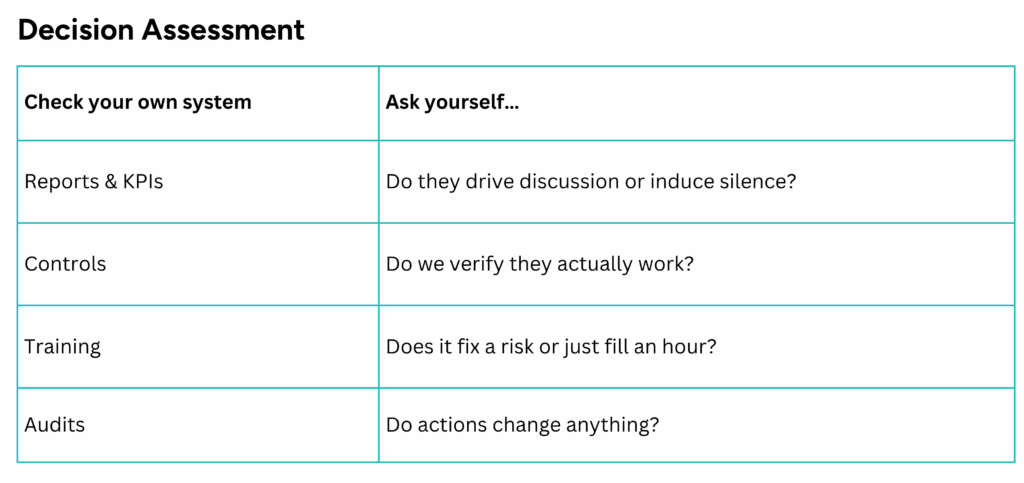
By cutting what doesn’t drive benefit, safety leaders show respect for organisational investment — and gain the trust to ask for more when it truly matters.
Safety + Insurance = One Language
In her current role, Crystal leads both Safety and Insurance — a pairing that most organisations treat separately. She sees them as inseparable.
“Great safety management is great insurance management.”
Every insurer assesses two things: frequency of claims and defensibility. Lower harm reduces claims; stronger evidence improves defensibility. Both depend entirely on safety maturity.
Understanding that connection turns safety performance into direct financial leverage. Lower claims ratios translate into lower premiums, better renewals, and stronger relationships with underwriters.
Crystal’s advice for safety professionals:
- Meet your insurance team. Find out who manages renewals.
- Ask where defensibility fails. Missing training records? Weak investigations? Fix those.
- Track avoided claims. Show how fewer incidents or faster investigations reduce exposure.
- Use success stories. If a recurring injury type disappears across multiple sites, tell your insurer — that’s evidence of improved risk quality.
“Insurance is usually seen as a business cost we just accept. But when you link it to safety performance, it becomes a measure of how mature your organisation really is.”
Leadership, Courage & Commercial Empathy
Behind the metrics lies mindset. Crystal’s journey is filled with courage — not just the courage to act, but the courage to change language.
“You never understand how big your boots are until you stamp your feet. Just be mindful when and where you stamp.”
Effective safety leaders, she says, balance three traits:
- Courage – to challenge norms and show results before permission.
- Self-awareness – to recognise when passion must be translated into business logic.
- Empathy – to appreciate what the organisation already invests before asking for more.
She warns against “empire-building” mindsets — creating roles or layers simply to look more influential.
“Every role I write myself. If it doesn’t solve a defined problem, it’s an unfair request on the organisation.”
The same discipline applies to systems and processes. Every app, every audit, every training module must have a purpose that ties back to risk reduction or business improvement. Anything else is clutter. This clarity earns credibility. Boards trust leaders who demonstrate they’re as protective of company resources as they are of people.
“When I walk in and say I need a new role or system, they know I mean it — because I’ve already proven I’ll squeeze every ounce of value out of what I’ve got.”
From Compliance to Value Creation
So what happens when safety truly learns the language of business?
- Investment flows more easily. Boards fund what they understand. Show ROI, and “no” becomes “how soon.”
- Insurance premiums stabilise or fall. Lower harm, fewer claims, higher defensibility — a direct bottom-line win.
- Engagement rises. People see safety not as rules to follow but as strategy to believe in.
- Leaders trust safety as a partner. The conversation shifts from compliance to competitiveness.
“Jet pilots don’t have rear-view mirrors – keep looking forward.” — Nathan Hight
Translating safety into business language doesn’t mean abandoning the moral core. It means uniting heart and head so that doing the right thing also becomes the smart thing.
Conclusion
Crystal Danbury’s True Cost of Harm framework is more than a financial model. It’s a new dialect for safety leadership — one that fuses empathy, evidence, and enterprise.
For safety professionals aiming to influence at executive level, the path is clear:
- Stop saying “you should.” Start showing “here’s the ROI.”
- Simplify the metrics; amplify the insight.
- Respect the organisation’s investment; demonstrate the return.
- Measure not just harm, but value created.
When safety leaders learn to speak business, business learns to invest in safety. That’s when culture shifts, controls work, and performance follows.